You can jump start a Jeep Wrangler with jumper cables, a donor vehicle, and careful battery connections.
A Jeep Wrangler is built for adventure, but a dead battery can stop even the best trail day in its tracks. I’ve seen this happen more times than I can count, and the fix is usually simple if you follow the right steps. In this guide, I’ll walk you through how to jump start a Jeep Wrangler safely, what to check before you begin, and the mistakes that can turn a small problem into a bigger one.

What you need before jump starting a Jeep Wrangler
Before you try to jump start a Jeep Wrangler, gather the right tools and check the battery area. A little prep goes a long way here, because a rushed jump start can damage electronics or create sparks.
You will need:
- Jumper cables in good condition
- A working donor vehicle or jump pack
- Safety gloves and eye protection if available
- A clean, dry spot under the hood
- The Jeep in Park or Neutral, with the parking brake set
If the battery is cracked, leaking, swollen, or smells like rotten eggs, stop right away. That usually means the battery is damaged and should not be jump started. In that case, a replacement is the safer move.

How to jump start a Jeep Wrangler step by step
Learning how to jump start a Jeep Wrangler is mostly about connection order and patience. The process is simple, but each step matters because modern Wranglers have sensitive electrical systems.
Follow these steps:
- Park the donor vehicle close enough for the cables to reach, but do not let the vehicles touch.
- Turn both vehicles off and remove the keys or push-button fobs from the ignition area.
- Open both hoods and find the batteries or jump points.
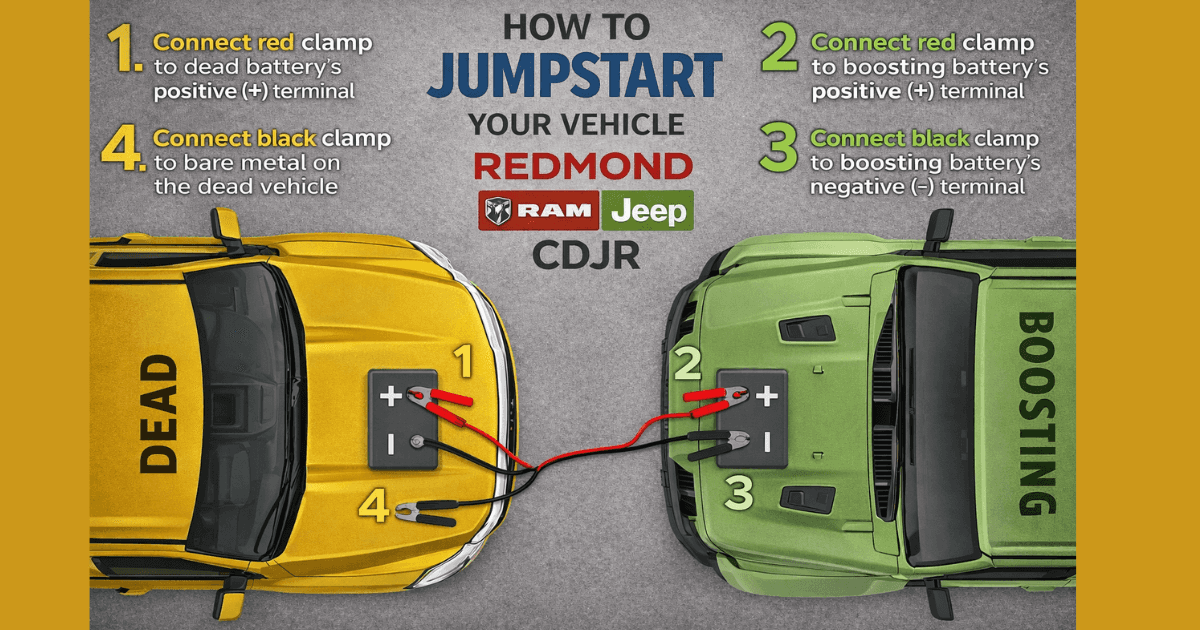
- Connect the red cable clamp to the dead Jeep’s positive battery terminal.
- Attach the other red clamp to the donor vehicle’s positive terminal.
- Connect the black cable clamp to the donor vehicle’s negative terminal.
- Attach the last black clamp to an unpainted metal ground on the Jeep Wrangler, away from the battery.
- Start the donor vehicle and let it run for a few minutes.
- Try starting the Jeep Wrangler.
- Once it starts, leave both vehicles running for a short time before removing the cables in reverse order.
The reverse order is important because it helps reduce the chance of sparks near the battery. I’ve always told people to think of it like turning a faucet on and off in the right order. If you rush the last step, you can create the very problem you were trying to avoid.

Where to connect the jumper cables on a Jeep Wrangler
The exact connection point can vary a bit by model year, but the rule stays the same: positive to positive, and negative to ground. On many Jeep Wranglers, the battery is easy to access under the hood, which makes the process easier than on some newer vehicles.
A safe setup usually looks like this:
- Red clamp to the Jeep battery positive terminal
- Red clamp to the donor vehicle battery positive terminal
- Black clamp to the donor vehicle negative terminal
- Black clamp to a solid metal ground on the Jeep, such as a clean bolt or engine bracket
Do not connect the final black clamp directly to the dead battery’s negative terminal if you can avoid it. Grounding away from the battery lowers spark risk. That small detail has saved a lot of headaches in my experience.

Safety tips before you jump start a Jeep Wrangler
When people ask how to jump start a Jeep Wrangler, I always say safety comes first. A battery stores a lot of energy, and that energy deserves respect.
Keep these safety tips in mind:
- Wear eye protection if you have it
- Keep metal tools away from the battery terminals
- Do not smoke near the battery
- Make sure the cables are not frayed or cracked
- Never let the clamps touch each other while connected to a battery
- Stop if the battery is hot, leaking, or visibly damaged
Also, avoid standing directly over the battery when trying to start the Jeep. If a battery has an internal failure, it can vent gas or crack. It is rare, but it is not worth taking the chance.

Common reasons a Jeep Wrangler battery dies
A dead battery does not always mean the battery itself is bad. Sometimes the real issue is something else draining power. Knowing the cause helps you avoid getting stranded again.
Common causes include:
- Leaving the lights, radio, or accessories on
- A battery that is old and near the end of its life
- Corrosion on the terminals
- A weak alternator that is not charging properly
- Extreme cold weather
- A parasitic draw from an electrical component
From hands-on experience, I’d say corroded terminals are one of the most overlooked problems. I’ve seen Wranglers that seemed dead simply because the cable ends were crusted up and making poor contact. A quick cleaning can sometimes make a huge difference.
What to do after the Jeep Wrangler starts
Once you get the Jeep Wrangler running, do not shut it off right away. The battery needs time to recover, and the alternator needs time to recharge it.
After a successful jump start:
- Let the Jeep idle for at least 15 to 30 minutes
- Drive it if possible, since driving helps recharge the battery better than idling
- Turn off accessories like the heater, seat warmers, and high beams
- Watch for warning lights on the dashboard
- If the Jeep dies again soon after, have the battery and charging system tested
If the battery only starts the Jeep after a jump and then fails again later, that is a strong sign the battery may need replacement. A healthy charging system should not need repeated jump starts.

How to know if the battery needs replacement
A jump start is a fix for the moment, not always the full solution. If you keep having to jump start a Jeep Wrangler, the battery or charging system may be the real issue.
Signs you may need a new battery:
- The Jeep cranks slowly every morning
- You need frequent jump starts
- The battery is more than 3 to 5 years old
- The battery case looks swollen or damaged
- Headlights dim when the engine is off
- Electrical accessories behave oddly
Battery life depends on climate, use, and maintenance. In hot or very cold areas, batteries often wear out faster. I’ve seen some last longer, but once a battery starts acting weak, it usually does not get better on its own.

Can you jump start a Jeep Wrangler with a jump pack
Yes, a portable jump pack can be a great option for how to jump start a Jeep Wrangler. In fact, for many drivers, it is easier than finding another vehicle.
A jump pack is useful because:
- It works even when no donor car is nearby
- It is compact and easy to store
- It reduces the need to manage two vehicles
- It can be safer in tight parking spaces
Just make sure the jump pack is fully charged and rated for your Jeep’s engine size. Follow the jump pack instructions, because different models can have slightly different connection steps. I keep one in my own vehicle kit, and it has saved me from a lot of unnecessary stress.

Mistakes to avoid when jump starting a Jeep Wrangler
A simple jump can go wrong fast if you skip the basics. Most problems happen because someone is in a hurry or assumes all batteries are the same.
Avoid these mistakes:
- Connecting cables in the wrong order
- Letting the clamps touch each other
- Using damaged jumper cables
- Jumping a frozen or visibly damaged battery
- Revving the donor vehicle too much
- Shutting the Jeep off immediately after it starts
- Ignoring repeated battery failures
One of the most common mistakes I’ve seen is connecting the black clamp to the wrong spot. That can create sparks near the battery, and it is easy to avoid by choosing a clean metal ground. Small habits like that make the whole job safer.
When not to jump start a Jeep Wrangler
There are times when jump starting is not the right move. If the battery is damaged or the electrical system shows serious warning signs, forcing a jump can make things worse.
Do not jump start if:
- The battery is cracked, leaking, or swollen
- You smell strong sulfur or burning odors
- The cables or terminals are badly corroded and unstable
- The Jeep has electrical damage from flooding
- The battery is frozen
- The vehicle shows signs of smoke or melted wiring
In those cases, call roadside assistance or a mechanic. That may feel slower, but it is safer and often cheaper than causing more damage.
Frequently Asked Questions of how to jump start a jeep wrangler
Can you jump start a Jeep Wrangler with another SUV?
Yes, as long as the donor vehicle has a healthy 12-volt battery and is running the same basic electrical system. The key is using correct cable connections and a stable donor power source.
How long should you leave jumper cables on before starting the Jeep Wrangler?
Usually a few minutes is enough to transfer some charge to the dead battery. If the Jeep still does not start after one or two tries, stop and check the battery, cable connections, and possible battery damage.
Can a Jeep Wrangler battery be too dead to jump start?
Yes, if the battery is severely damaged, frozen, or internally shorted, a jump start may not help. If the Jeep still will not crank after proper connections, the battery may need replacement or the issue may be elsewhere.
Should the donor vehicle be running when jump starting a Jeep Wrangler?
Yes, in most cases the donor vehicle should be running to supply power. Let it idle steadily before and during the first start attempt so the dead Jeep gets a more stable charge.
How do you know if the jump start worked?
If the Jeep Wrangler starts and stays running without stalling, the jump likely worked. You should still test the battery and charging system soon, especially if the vehicle has been struggling for a while.
Conclusion
Knowing how to jump start a Jeep Wrangler can save time, money, and a lot of frustration. The process is simple once you understand the cable order, the safety steps, and the signs that point to a bigger battery problem. If your Wrangler needs repeated jump starts, treat that as a clue, not just an inconvenience, and have the battery and charging system checked soon.
The best takeaway is this: stay calm, connect carefully, and do not ignore the warning signs. A little attention now can keep your Jeep ready for the next road or trail ahead. If this guide helped, explore more vehicle care tips and share your own Wrangler battery experience in the comments.